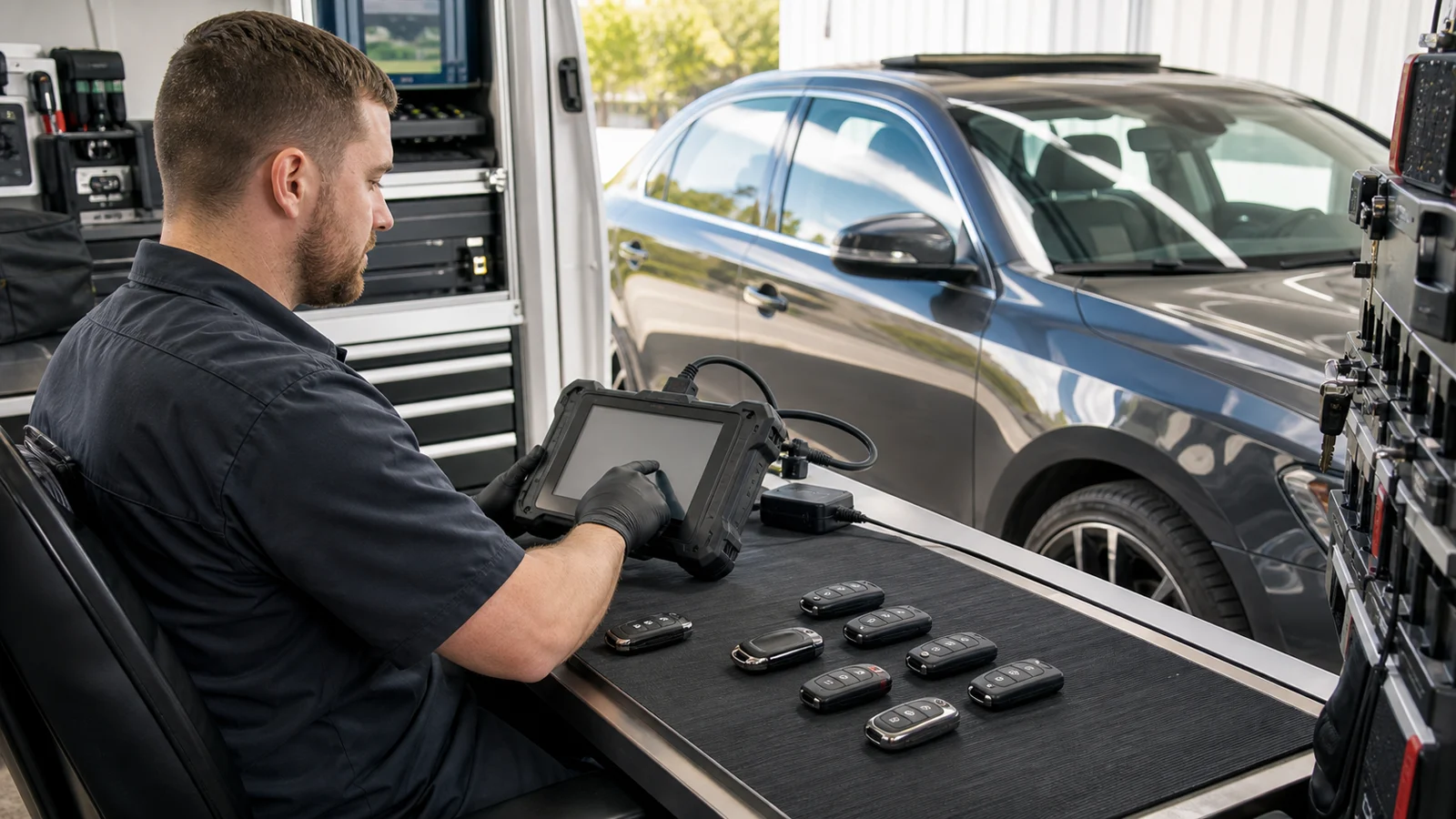
Key Fob Programming equipment and vehicle-key detail

San Mateo vehicle key guide

Key Fob Programming in San Mateo

Before equipment comes out in San Mateo, the useful questions are about the vehicle, the key state, the location, and what changed immediately before the problem appeared. A fob that looks correct can still use the wrong frequency, board, transponder, or proximity configuration. Compatibility must be confirmed before programming is attempted.

  • Vehicle-specific scope
  • Ownership verification
  • Function-by-function testing

Start with the symptom

Describe what the vehicle does now

In San Mateo, a location described only by street address may omit the practical access issue: Caltrain lots, downtown garages, apartments, and residential drives can require a gate code, garage clearance, stall number, or safe meeting point.

Say whether a working key remains, whether the doors respond, whether the engine cranks or starts, and whether the problem is mechanical, electronic, or both. Those details narrow the equipment and key-system questions before anyone treats the vehicle badge as a diagnosis.

Keep failed parts until the result is verified. The old blade, shell, battery, or fob can provide identifiers that are difficult to reconstruct later.

A five-checkpoint process

What a careful service path should include

  1. 1
    Identify the exact vehicle and existing key state

    Checkpoint 1: This keeps the decision tied to the actual vehicle rather than a generic key assumption.

  2. 2
    Check part, frequency, board, and transponder compatibility

    Checkpoint 2: This prevents a guess from turning into the wrong service path.

  3. 3
    Confirm whether all-key-lost or add-a-key programming applies

    Checkpoint 3: This keeps the decision tied to the actual vehicle rather than a generic key assumption.

  4. 4
    Program supported functions with vehicle-specific equipment

    Checkpoint 4: This prevents a guess from turning into the wrong service path.

  5. 5
    Test lock, unlock, start, and proximity behavior where equipped

    Checkpoint 5: This gives the technician a verifiable checkpoint before moving forward.

Compatibility before parts

The key system determines the work

Mechanical blades, transponder chips, integrated remotes, proximity fobs, and emergency inserts solve different parts of access and authorization. Two keys can share the same outer shape while using different electronics. Record the vehicle identification number only through a secure service channel; do not publish it or send it into an unverified form.

When one working key remains, the available process can differ from an all-keys-lost situation. When no key remains, additional identification and immobilizer steps may be required. The correct answer depends on the exact vehicle configuration and cannot be guaranteed from a generic online photo.

Before authorizing work, repeat back the included functions. A replacement that turns the ignition but lacks expected remote behavior is not the same scope as a complete multi-function key.

Local access in San Mateo

Make the vehicle reachable

When the final approach leaves US-101, CA-92, El Camino Real, and Hillsdale Boulevard, identify the correct driveway, garage entrance, curb zone, or controlled lot. Confirm that work can occur lawfully and away from moving traffic.

Share the stall level, gate instructions, clearance limits, cross street, and a safe place to meet when those details apply. If the vehicle is in traffic, on a freeway shoulder, or creating a life-safety concern, contact the appropriate emergency or roadside authority first.

A location plan is part of the service plan. It reduces time spent searching a large lot and prevents an arrival at a space where doors cannot open, equipment cannot be positioned, or property access has not been authorized.

Before you approve the scope

Ask what is included and how it will be tested

An estimate should identify the intended result: entry only, a mechanical key, a programmed transponder, remote functions, proximity functions, ignition diagnosis, or a combination. Ask whether taxes, hardware, programming, and service travel are included before authorizing work.

Do not rely on a price that remains detached from the vehicle and desired functions. A useful quote names its assumptions. If inspection changes those assumptions, pause and approve the revised scope before additional work begins.

Afterward, test the agreed functions while the technician is present. Keep the invoice and any key identifiers in a secure place, separate from the vehicle.

Bring to the conversation
  • Photo ID and lawful-control documentation
  • Year, make, model, and trim when known
  • Every existing key, fob, and broken piece
  • Exact parking and access instructions
  • The specific functions you expect afterward

A San Mateo-specific work plan

Turn local access and vehicle evidence into a controlled handoff

Map the final approach

Begin with the vehicle's precise position in Caltrain lots, downtown garages, apartments, and residential drives. A street address alone may not reveal a garage level, controlled gate, assigned stall, loading restriction, or safe place to meet. Describe the final approach from US-101, CA-92, El Camino Real, and Hillsdale Boulevard and identify any point where a larger service vehicle cannot continue.

Describe the symptom sequence

For remote and smart-key compatibility diagnosis, record what worked immediately before the failure and what still works now. A blade that enters but will not rotate, a remote that unlocks but will not start, and a proximity fob that works only in a backup position point to different checkpoints.

Authorize a defined result

Before work begins, restate the requested outcome in functional terms. Entry, ignition rotation, engine authorization, remote buttons, trunk control, panic, passive entry, and passive start should be treated as separate test items.

Verify before departure

Close the visit with a repeatable test rather than a general statement that the key works. Walk through each paid function, record limitations, and ask which existing keys remain authorized.

Deeper vehicle-key planning

Turn the symptom into a verifiable service scope

Build a useful symptom timeline

Describe the last successful use and the first failed use. A sudden failure after impact, water exposure, battery replacement, or a jump-start suggests a different investigation than a blade or cylinder that became gradually harder to use.

Also note whether a spare key changes the result, whether the vehicle battery has recently been weak or disconnected, and whether dashboard security indicators behave differently. Do not keep repeating a step that increases resistance, heat, noise, or damage.

Confirm compatibility before irreversible work

A key shell is cosmetic; the security work happens in the blade geometry and electronics. Two shells can look identical while their internal boards or transponders differ. Confirm the supported function set before paying to cut or program a part.

Cutting a blade or opening sealed packaging can limit return options. Ask which identifiers were checked and preserve the old parts, labels, and purchase records until the replacement has passed its complete test.

Keep separate decisions separate

A battery replacement is a useful check only when the battery type, orientation, contact condition, and fob case are correct. A new battery cannot repair a cracked board, damaged antenna, wrong-frequency fob, or vehicle-side recognition problem.

Ask whether programming is add-a-key or all-keys-lost. The distinction affects risk and procedure. After programming, confirm that every key intended to remain active still works and that no expected function disappeared.

Make the estimate auditable

A low opening figure is not useful when it omits the key type, programming state, or requested functions. Compare written assumptions rather than headline numbers, and require approval before an expanded scope begins.

Ask what finding could change the amount and what happens if the proposed part cannot be programmed. Do not approve a broader service merely because equipment is already connected to the vehicle.

Vehicle and property care

Plan a safe working position in San Mateo

A vehicle on a traffic lane, freeway shoulder, steep drive, active loading zone, or restricted property may need to be moved or made safe before routine service begins. Around US-101, CA-92, El Camino Real, and Hillsdale Boulevard, the practical service setting may be Caltrain lots, downtown garages, apartments, and residential drives. Share access restrictions before dispatch so the requested work can be evaluated at a reachable, safe location.

Tell the dispatcher about low garage clearance, underground levels, gate access, tow-yard rules, airport or campus restrictions, and whether the vehicle can be reached from both sides. Do not ask a technician to work where passing traffic, poor lighting, unstable ground, or property rules make the setup unsafe.

If the vehicle has frameless glass, side-curtain airbags, custom security equipment, or visible prior damage, mention that before entry or trim work. Existing damage should be documented so the before-and-after condition is clear.

Closeout standard

Test the result while the vehicle is present

Use a written function list. Mechanical entry, ignition rotation, engine authorization, lock and unlock buttons, trunk release, panic button, passive entry, passive start, and emergency insert operation are separate checks. Test only the functions included in the approved scope, but test every one of those functions.

Where multiple keys remain active, test each one. Confirm that the new work did not disable an existing key that was supposed to remain authorized. If a function is intentionally unavailable, put that limitation on the invoice rather than relying on memory.

Store invoices, part identifiers, and key records securely. Do not leave a key code, VIN record, or ownership document in an unlocked vehicle. If a lost key creates an ongoing security concern, ask what options exist for deauthorizing it on the exact vehicle.

The final phone check

What to say when calling from San Mateo

Give the year, make, model, trim when known, start method, number of working keys, and the exact symptom. Then describe where the vehicle sits in Caltrain lots, downtown garages, apartments, and residential drives and whether access from US-101, CA-92, El Camino Real, and Hillsdale Boulevard involves a gate, garage level, property manager, tow yard, or restricted lot.

Ask the dispatcher to repeat the requested result as remote and smart-key compatibility diagnosis. This catches a mismatch before travel or parts are committed. Confirm the callback number and exact meeting point before ending the call.

Your closeout note

Record what was delivered

Write down the functions tested, old keys that remain active, limitations disclosed, part identifiers provided, and the invoice total. Keep that note with the invoice, not in the vehicle.

If a lost key may still be in circulation, ask whether the exact vehicle supports deauthorization and whether that work was included.

Questions before you authorize work

Clear answers, fewer surprises

What should I have ready for key fob programming in San Mateo?

Have a photo ID, proof that you lawfully control the vehicle, the year/make/model, the exact location, and every working or non-working key or fob available.

Can the final scope be confirmed from the vehicle make alone?

No. Model year, trim, key state, blade, transponder, remote functions, and immobilizer generation can change the required path.

Should I buy a key or fob online before compatibility is checked?

Not necessarily. A shell can look identical while the board, frequency, transponder, or proximity system differs. Confirm identifiers first.

What should be tested before the visit is considered complete?

Test every function included in the scope: mechanical entry, ignition or start authorization, lock/unlock buttons, trunk release, and proximity behavior where equipped.

Does this page promise immediate availability in San Mateo?

No. Call (877) 771-4458 to confirm current routing, service fit, and availability for the vehicle and location.

Confirm service fit and current routing

Call with the vehicle details

No availability, price, or outcome is promised by this page. A dispatcher must confirm the vehicle, location, and requested scope.

Call (877) 771-4458
Call (877) 771-4458